Showcase Your Innovations and Shape the Future of Skincare and Apparel Consumer Experience.
Builders, developers, and visionaries: it’s time to design solutions that redefine the next generation of consumer experiences. The YouCam API Skin AI & Apparel VTO Hackathon is your launchpad. We’re opening our most advanced, field-tested AI/AR infrastructure so you can move beyond the sandbox and build real products, including agentic AI workflows.
We want you to push innovation to its limits by integrating YouCam APIs into your big idea, whether it’s a self-learning styling AI agent, a personalized skin diagnostic tool, or a solution to real user problems. Bring your boldest architectural concepts—and we’ll back them with serious prize money.
About the challenge
All solutions must integrate at least one YouCam API and demonstrate clear consumer or retail value. Your solution needs to clearly align with whichever topic you choose, both in how it's built and how it's described.
Pick the topic that best fits your project and submit:
Skin AI
People don't wonder about their skin in the abstract, they wonder right before a purchase, right after a bad breakout, right when they're standing in front of a mirror deciding whether something is working. Build something that meets that moment. Use YouCam's Skin AI, alone or combined with other YouCam APIs, to help someone understand their skin and know what to do next.
Apparel Virtual Try-On
Most online shopping decisions still come down to a guess, will this fit, will this look right, is it worth the return shipping. Build something that replaces that guess with something closer to certainty. Use YouCam's generative Apparel VTO, alone or paired with other YouCam APIs, to help someone make a buying decision with more confidence.
Skin AI + Apparel VTO
Beauty and fashion decisions rarely happen in isolation, what someone wears and how their skin looks are part of the same self-image. Build something that brings Skin AI and Apparel VTO together into one experience, rather than treating them as two separate features. We want to see what's possible when both capabilities work as one.
Why Join
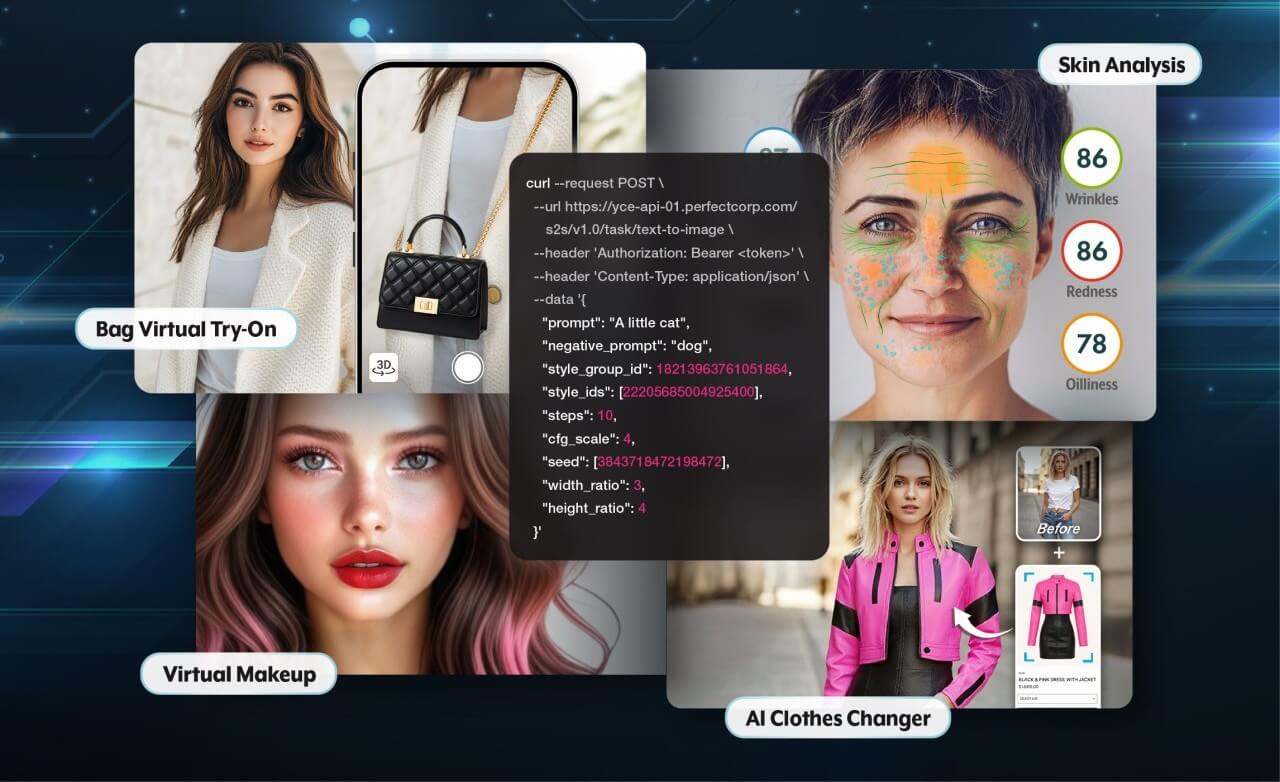
- Build with YouCam API. Access AI Skin Analysis and generative Apparel Virtual Try-On, the same models powering 800+ global beauty and fashion brands, on a standard REST API that drops into any stack.
- Get free API units to build, deploy, and demo. Every registered participant receives 1,000 free API units (a $179 value) just for signing up.
- Win cash, API credits, and real visibility. $5,000 for 1st place, $1,000 for 2nd, and API units for 3rd-5th, plus a feature on the Perfect Corp. blog for standout teams.
Get started
- Register on Devpost. Get your exclusive redeem code by email (2 minutes)
- Sign up for YouCam API. Click here to sign up and verify your email. (2 minutes)
- Claim Your Free 1,000 YouCam API Units. Click here and go to Account > Redeem Code > Enter the redeem code (3 minutes)
- 1,000 API Units will be added to your account immediately.
 Hosted on Devpost